 Revela
Doctoral thesis defence: Earth Sciences
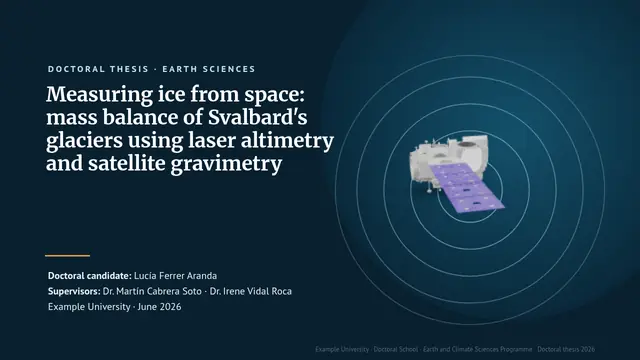
Doctoral thesis defence of about 50 slides on the ice of Svalbard measured from space: cover with a 3D satellite, a map of the area that travels, 3D instruments, method, results with charts, discussion, conclusions, conference attendance with the map flying from one to the next, derived publications, other merits and backup slides for the committee's questions.
- 50 slides
- Free, nothing to install
- Downloads as PowerPoint
What’s inside
How to use it
- Click Use this template: it opens in Revela, in your browser. Nothing to install.
- Replace the text, images and data with your own. The speaker notes tell you what to say on each slide.
- Present it with your phone as a remote, share it with a link or download it as PowerPoint.
More in Science and university
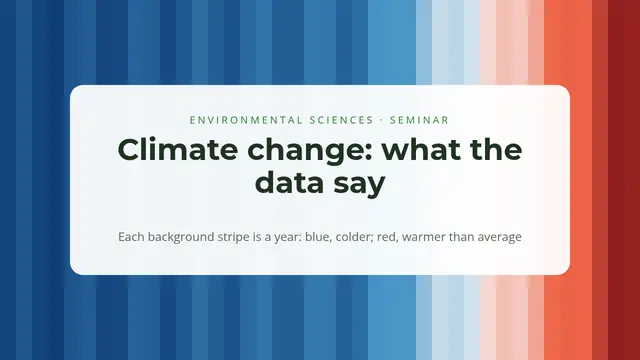 Climate change in dataWarming stripes, line, area and treemap charts, greenhouse effect that draws itself, 3D satellite, cycle and multiple-choice vote
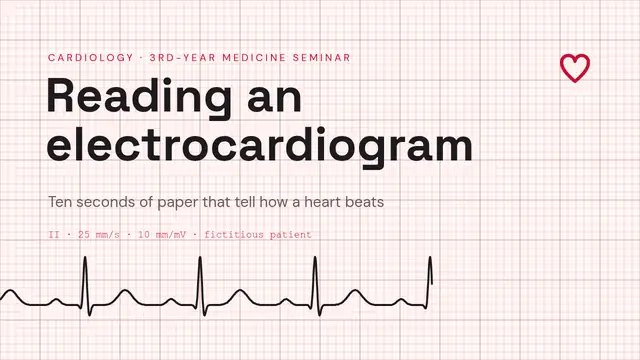 Cardiology: reading an ECGECG paper: traces that draw themselves, an impulse travelling through the heart, table with formulas, equation, quiz and countdown
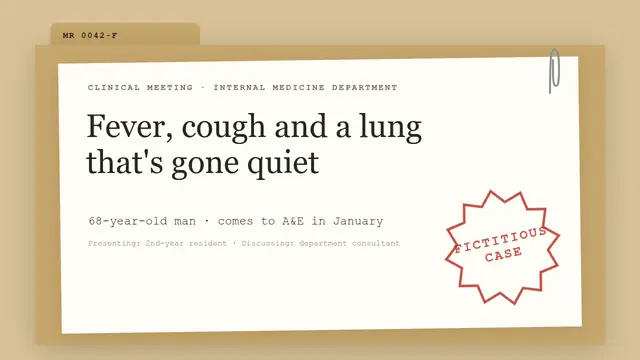 Clinical case: fever and coughMedical record style: folder, stamp, X-ray on a light box with a circle that draws itself, CURB-65 with a formula, poll and questions
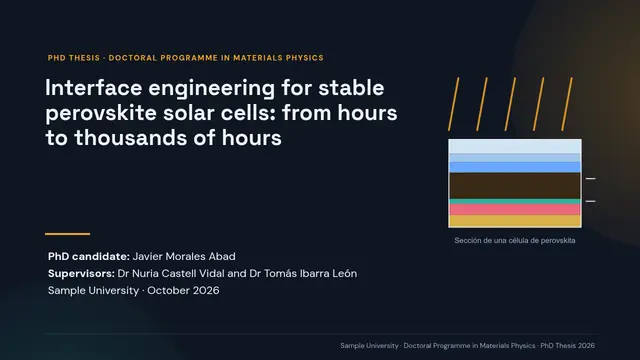 PhD thesis defence: Materials PhysicsPhD thesis defence presentation for Materials Physics and Engineering: cover, figures on the problem, research questions, chapter structure, state of the art, methodology with equations, results with curves and charts, original contributions, resulting publications, conclusions, backup slides for the committee's questions and notes with 45-minute timings
 Bachelor's thesis defence: Business Administration and business planBachelor's thesis defence presentation for Business Administration (business plan): cover, the opportunity in figures, question and objectives, methodology, market survey, SWOT matrix, marketing mix, income statement, NPV and IRR with their formula, break-even point in a chart, conclusions, backup slides (assumptions, sensitivity and committee questions) and notes with the timings
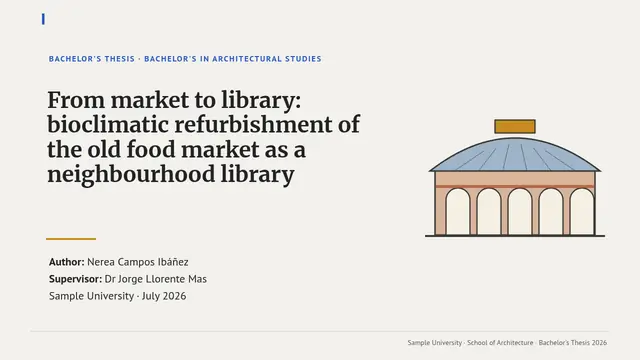 Bachelor's thesis defence: ArchitectureBachelor's thesis defence presentation for Architecture (refurbishment project): cover with a drawn elevation, the problem in figures, question and objectives, site and context, generating idea, drawn plan and section, bioclimatic strategy, materials, building code compliance in a table, conclusions, backup slides (energy demand, budget and committee questions) and notes with the timings